Arborist Service in Jacksonville, FL
Find out How Serious Your Tree Situation is
Arborist assessments to help homeowners and property managers make informed decisions about their trees — from an ISA Certified Arborist with the experience and the equipment for the job.
ISA Certified Arborist Services
Tom Jackson · ISA Certified Arborist (FL-378340A) · ISA Tree Risk Assessor
We take pride in our work, and our strength is our team, enabling us to provide the best tree service in Jacksonville.
As ISA Certified Arborists we can provide arborist assessments to assist homeowners and property managers make informed decisions about their trees. We respond to every inquiry quickly and strive to provide impeccable tree trimming and tree removal services. We provide all of our clients with fair and accurate quotes so that they can reliably estimate the cost of tree removal.
If you are thinking of hiring a tree service professional, you can see Jax Tree Removal has the experienced Certified Professionals and the right equipment for all of your tree service needs.
When to Get a Risk Assessment on Your Tree
We rarely think to lift our gaze. We pass by the same trees every day, week after week, so that eventually we barely notice they are there at all. But all of a sudden it is the middle of the night and in the middle of a storm and you wake up to a branch the size of your forearm lying across your driveway. Then you start thinking about calling an arborist.
But what many people fail to realize is that there are usually clear signs that this will happen, sometimes a month or more ahead of time. We see this at least once a week in Jacksonville. The story from homeowners is often, "This tree just came down, it was fine last week." But the indications were usually already there.
Look for some of the following signs:
- ✓Cracks and splits in the trunk or main branches
- ✓Fungi or other growth in or around the root system
- ✓A fresh or recent lean (especially a sudden new lean after heavy rains)
- ✓Dead wood in the upper canopy
- ✓Bald spots or peeling bark, which may reveal rot
Any of these could indicate a failing tree. This is of concern if the tree is near your home or your fence. Or even the car of the guy next door, like the case of the mature live oaks in San Marco we were asked about. The trees in question were in good condition on the surface, but we saw they have poor health from the root down due to construction done several years before and their root systems are dying.
Does it sound as bad as the day you call? Some people think maybe it was nothing. They are wrong. An arborist risk assessment is a simple evaluation where our certified arborist looks at many factors including tree structure, health, canopy, roots, and lean angles.
There is another category of trees, the ones struck by lightning. It is very common for lightning to strike trees in our area since Jacksonville ranks quite high when it comes to the number of lightning strikes a city sees each year. So even if the outside looks like the tree wasn't hit at all, the interior of the wood could be damaged and begin to rot. The branches could eventually fall apart and the whole tree break down in the next big storm.
If you suspect your tree has hollow spots, or is in need of tree decay inspections, don't wait until an accident occurs. You will need far less time to perform a risk assessment than it would take to clean up afterwards, and often it is much more affordable when your tree hasn't fallen.
Arborist Assessment
What does an arborist do? Assess and diagnose. We will give you the information you need to understand what condition your tree is in. It may involve doing a risk assessment on a large, live oak tree in your yard, which leans a little more every year. Or an inspection by an arborist on a hollow tree, like the water oak beside your yard on San Marco. Or an arborist report for your HOA or your insurance company. Arborist inspections aren't tree removal, so here's a rundown of the distinction: Tree removal is an action. Arborist service is a diagnostic tool that determines if an action should be taken on your tree.
A certified arborist can determine when a tree is suffering the early warning signs of root rot, fungus infestation, or structural failure, which may seem normal from the ground. A storm tree assessment after a major Jacksonville storm could show storm-damaged trees that are capable of being saved, which might otherwise seem too far gone from ground level. A lightning-struck tree inspection can inform you if your struck tree is safe, or needs to be pulled out immediately. We've seen this story played out several times in the last 10 years. Homeowners call for a tree removal. Our ISA certified arborist does an arborist assessment and quick examination and discovers the tree needs crown reduction or deadwood removal, both of which are less expensive than tree removal.
Not sure which service you need? Most of the time you should start with an arborist assessment. Look for the facts first. We'll help you out with tree removal, as well, if it's the right thing to do. It's like going to the dentist for a tooth pull before an exam or x-ray. Our ISA tree care team serves Jacksonville neighborhoods, from the Riverside old growth oak canopies to the newer Southside neighborhoods where developers planted trees too close to the home's foundation. The problems that develop differ based on neighborhood, species and soil type.
Certified, Qualified & Insured
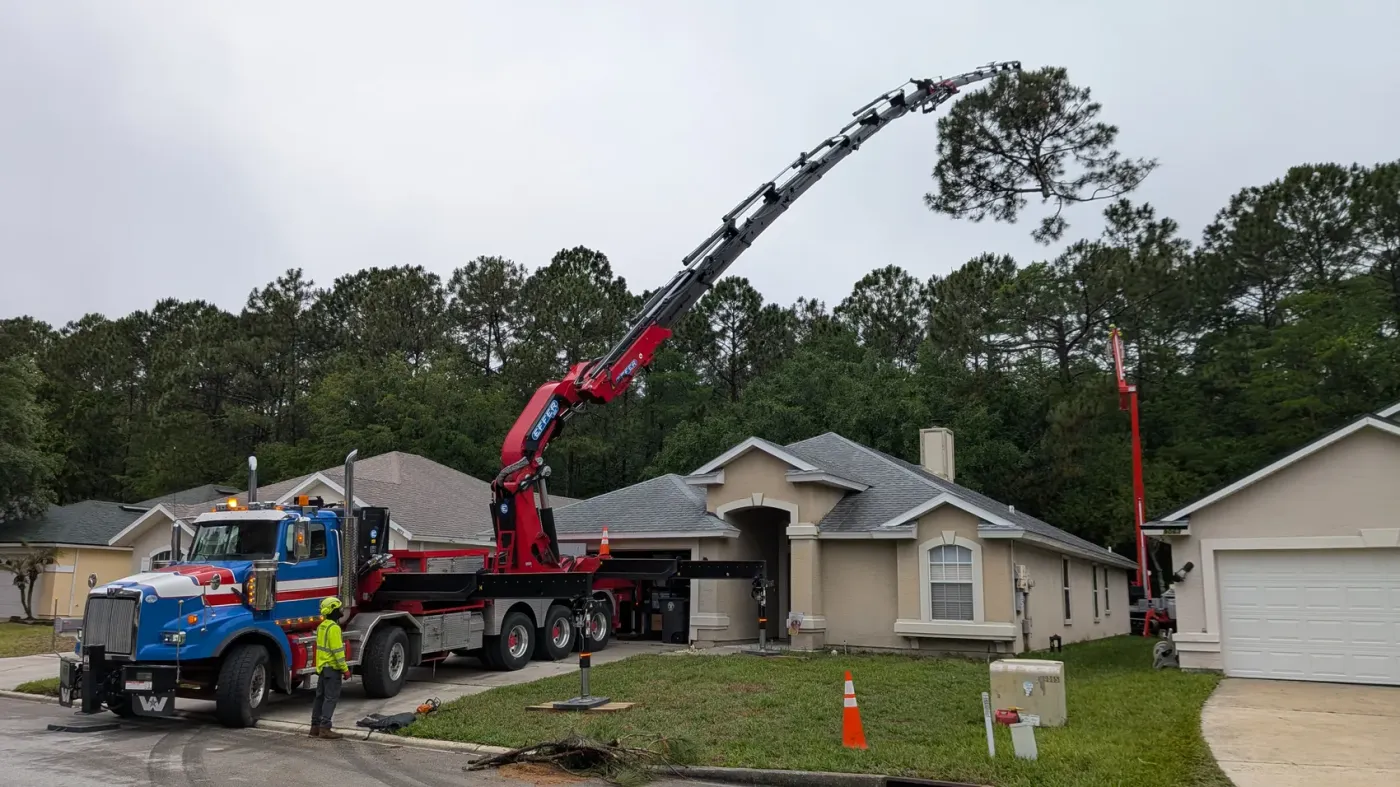
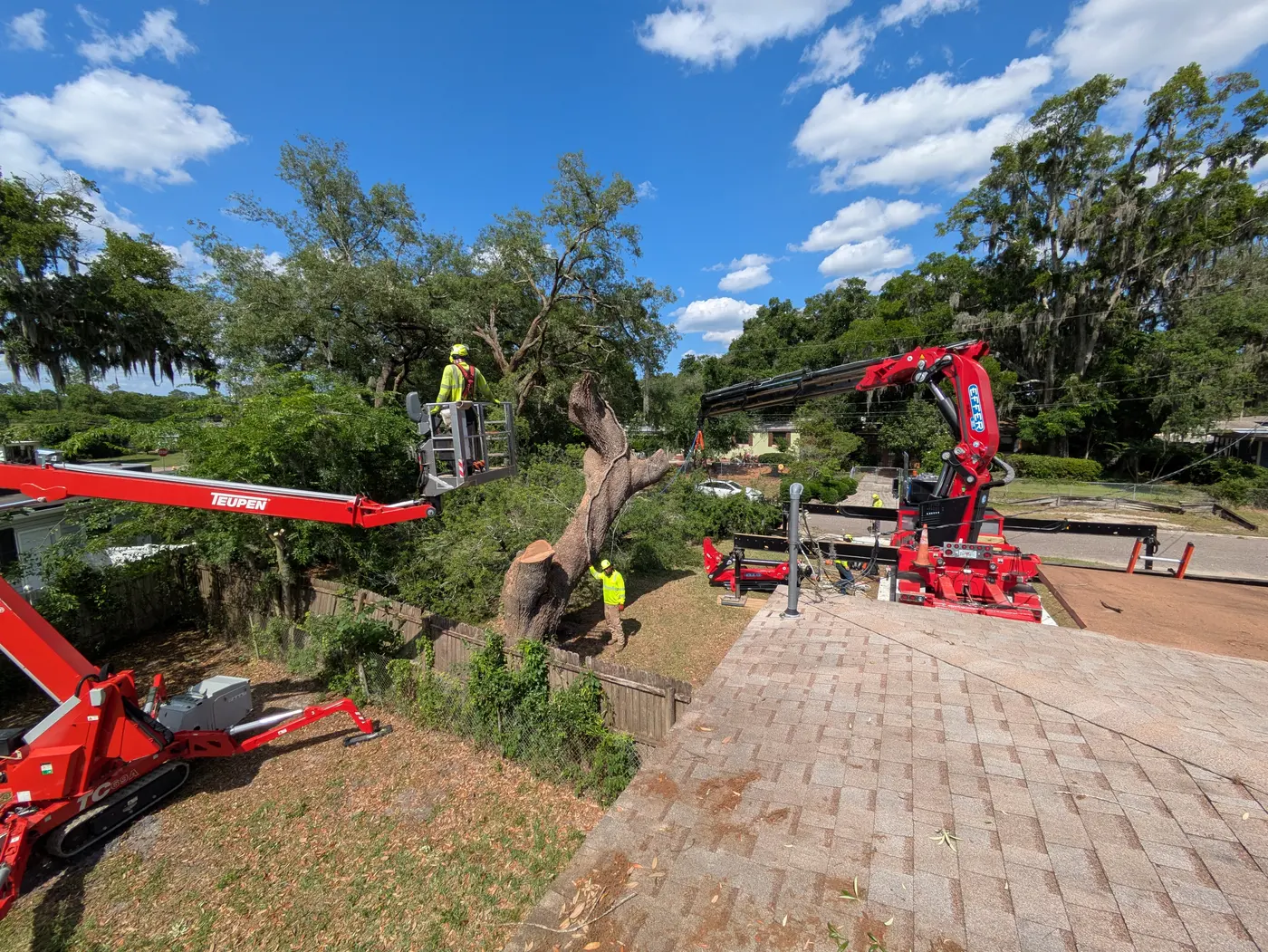
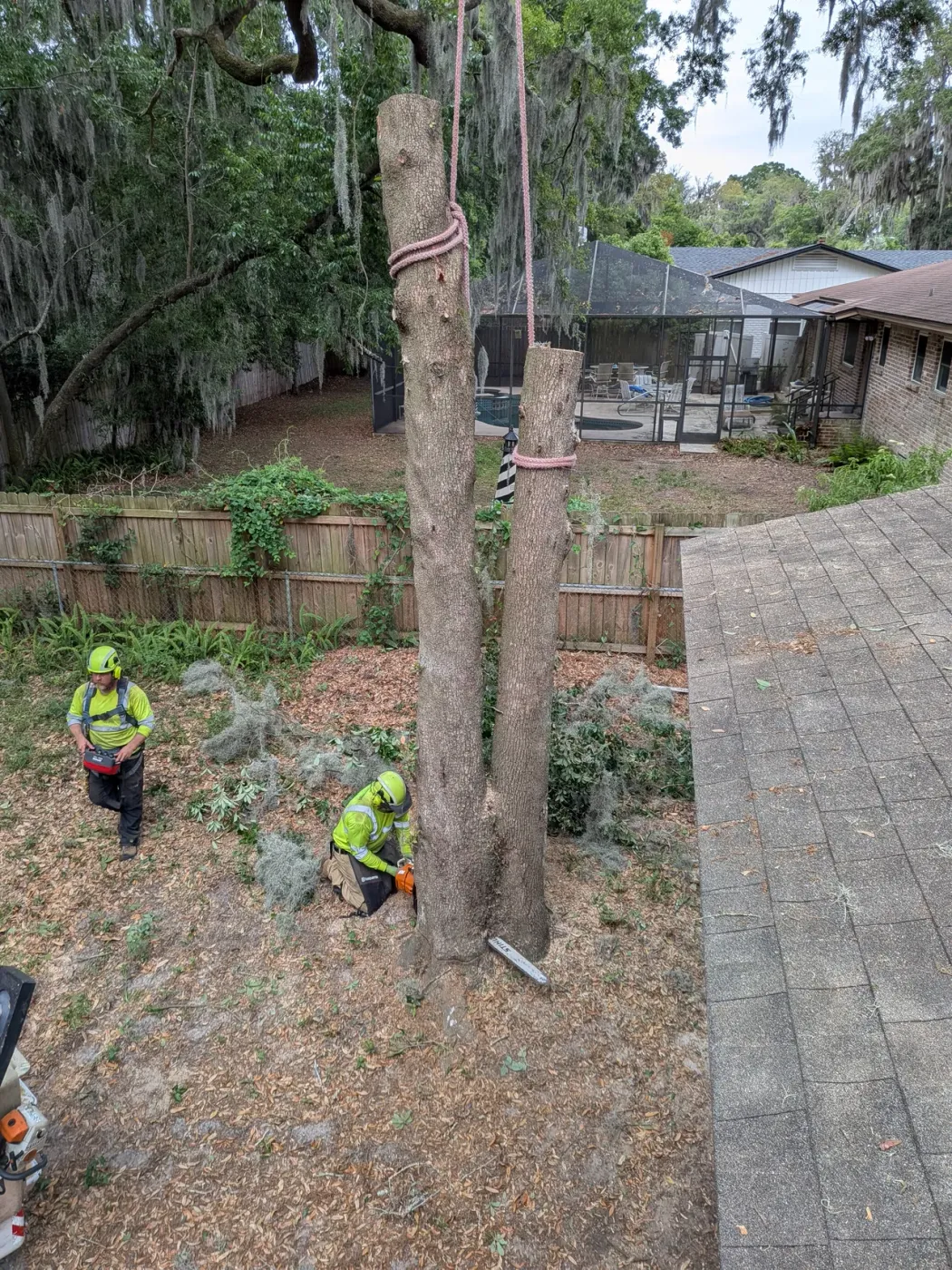
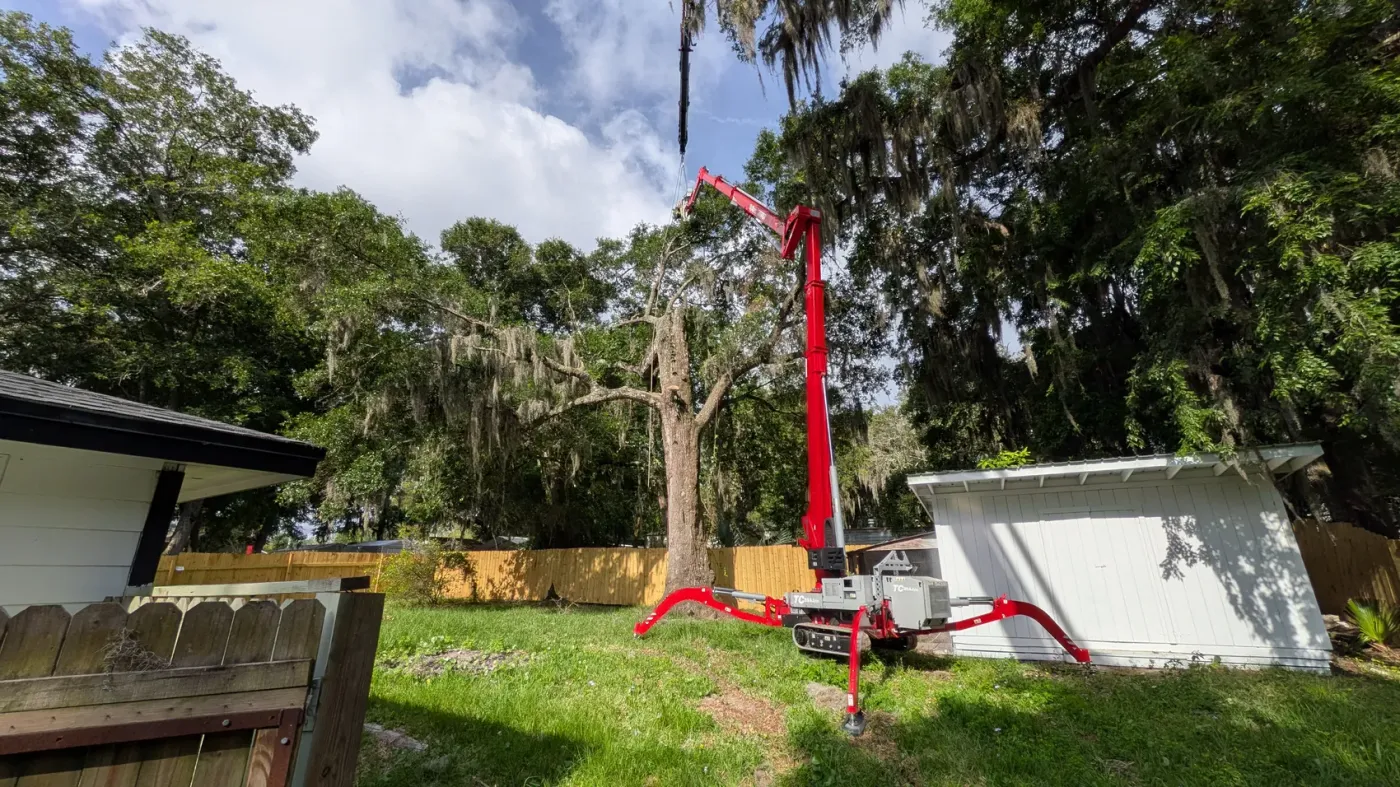
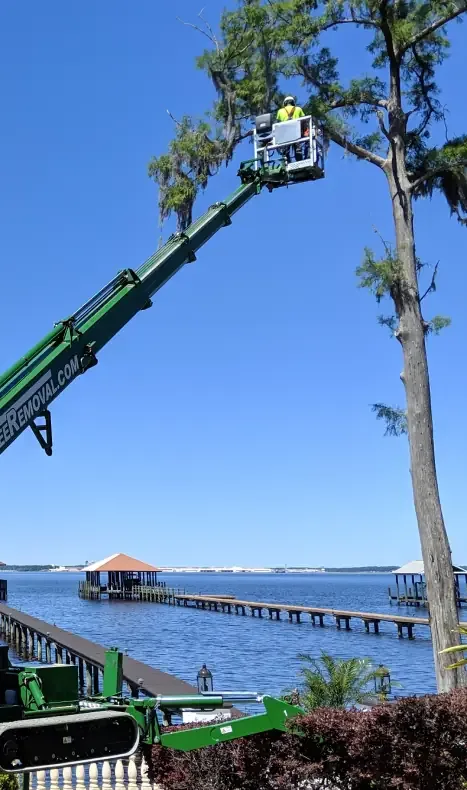
When a hazardous tree is leaning over your home, who does the work matters as much as the price. The crew that shows up is our own — a local, credentialed team that stays on the job from the first cut to the last. They arrive with the cranes and equipment we own and operate ourselves, so a big tree removal from the back yard or a low-hanging limb prune over the roof moves on your schedule and our standards. Our Team is led by an ISA Certified Arborist and TRAQ tree-risk assessor, and each crane is set by CCO-certified crane operators, with full insurance. Once the tree is removed or trimmed, we finish it up by hauling the debris, and leaving your yard the way we found it.
- Fully Insured
- ISA Certified Arborist
- ISA Tree Risk Assessor (TRAQ)
- CCO Qualified Crane Operator
- We Own our Cranes
- We Use our Equipment
- We Grind the Stumps
- We Haul the Debris
- Emergency Tree Service
Call now — or send the details
Tree on the house or a storm-damaged limb? Call and a real person answers, 24/7. Not urgent? Send the form and we'll get right back to you.
(904) 322-7799Available 24/7 for emergencies
Request A Free Estimate
Tell us about your tree, and we'll get right back to you.
Prefer to talk? Call (904) 322-7799
This site is protected by reCAPTCHA and the GooglePrivacy Policy andTerms of Service apply.
A Tree Risk Assessment involves?
It sounds like it's just a guy walking around a tree and looking at it. It is so much more than that. The process of performing a tree risk assessment follows a series of systematic steps outlined in the ISA Tree Risk Assessment best management practice guide and other standards described within the ISA. Every step of an arborist assessment is in evaluating the condition of your tree and site.
We do not guess and we do not provide a visual assessment to please you.
It is possible for a tree to pass a risk assessment and be preserved. For example, the reduction of branches may reduce the amount of wind force the tree encounters; the removal of a few dead branches may lower the risk assessment of a tree from high risk to moderate risk and it will still have the opportunity to be retained for as long as the conditions allow. The result of an arborist tree assessment is not always the removal of a tree. However, if removal is recommended it will be because of the details that are included in an arborist report, not simply personal opinion.
The total inspection typically takes between 60 - 90 minutes depending on the volume of the trees and the complexity of the job site. For example, an inspection in Arlington with several large live oaks would take longer than that of a single palm tree in The Beaches.
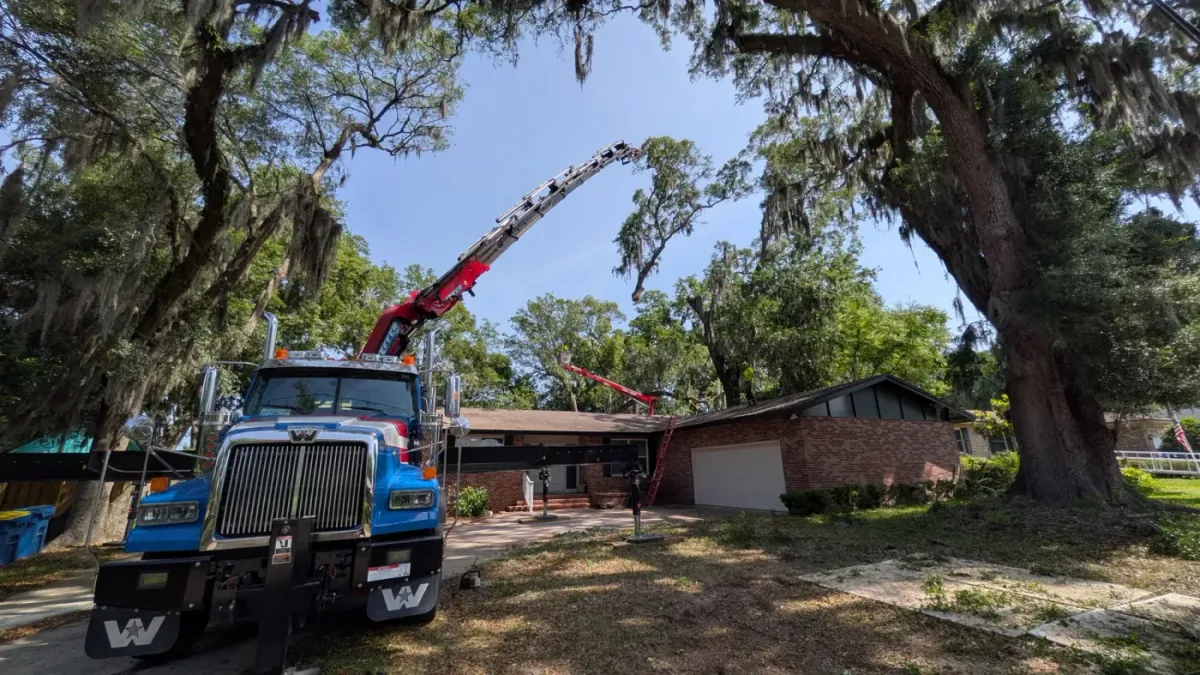
The Peril of Hollow and Decayed Trees in Live Oaks
One of the challenges is that oak trees can have a full canopy with lush leaves on the surface yet still be rotten all the way through from the inside. This is very common in the older sections of Jacksonville, in neighborhoods like Ortega and Avondale, that are home to many oak trees that may be over a half-century old. You may have the greenest canopy on the block, but inside the tree there's so much hollow space that you might be able to climb up into the tree via a hollowed trunk.
This is the real peril of decay. You don't see it.
Usually, decay begins at an old pruning cut, unhealed storm damage, or an infection with fungus, and eventually it reaches the heart of the tree. You probably won't discover the problem until the trunk is studded with mushrooms or large strips of bark fall down on their own. By this stage, most of the tree's internal strength is gone. A hollow tree trunk simply isn't as strong as a filled trunk can be, which means it could fall at the drop of a summer thunderstorm and destroy your roof, fence, or car.
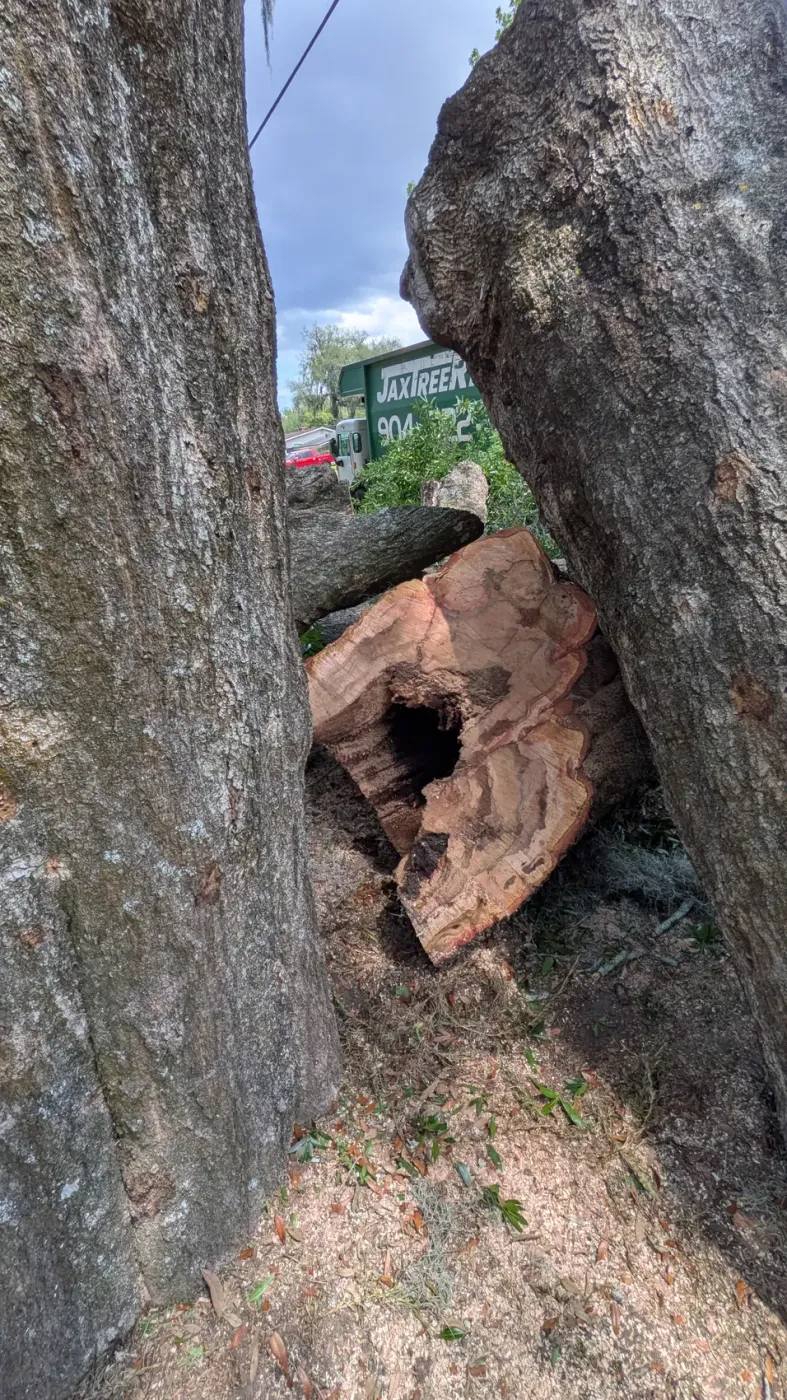
Symptoms of Hollow Tree and Decay
Most people call us because they spot one of these warning signs:
- ✓Fungal conks or mushrooms on the trunk or root flare
- ✓Sunken areas or holes that feel soft when pushed
- ✓A large chunk of bark that has fallen off without new bark growing below
- ✓Increasing lean in the past two years
- ✓Dying branches mostly clustered in one area of the crown
One of these symptoms can mean trouble. If you're seeing two or more signs, call an ISA-certified tree professional to assess the possible presence of hollow tree and decay.
Our ISA-certified tree surgeons will use visual tapping to estimate how much of the tree's wood still supports the tree. It's true that a lot of the tree has to be rotten before it would topple over, but at a certain point, a tree can no longer withstand wind. If the percentage of solid wood dips below that level, then the risk to your home is too high. We don't recommend tree removal unless it is necessary. We use cabling, pruning, and crown reduction as means to keep damaged trees alive and safely standing for several more years. However, if we believe a tree has gone past the point where we could help it live on, we do not hesitate to share our opinion and give the explanation for our thinking. If you need help with that, please give us a call!
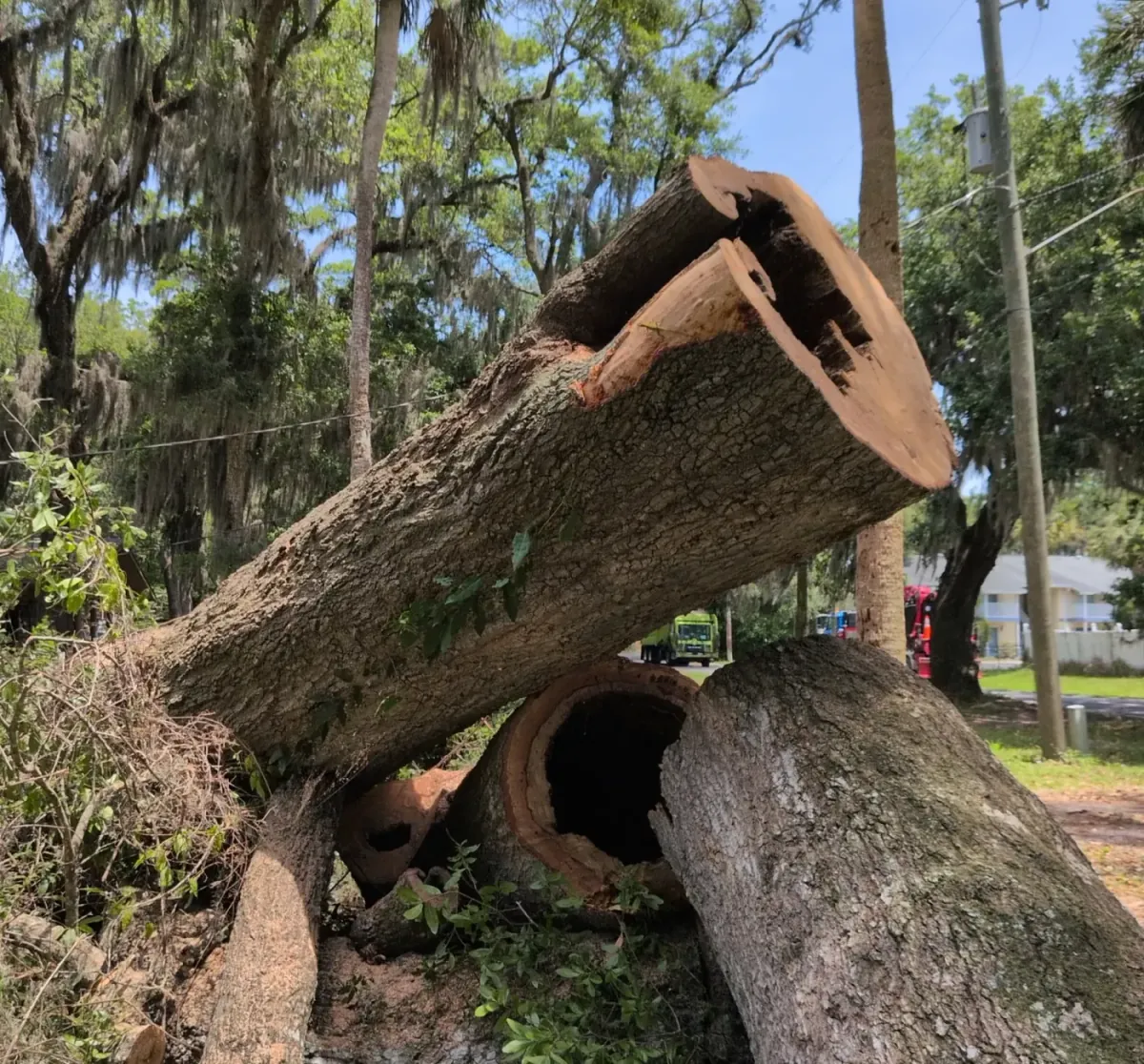
Storm or lightning damage to trees in Jacksonville
It's a big storm in Mandarin, Southside, and you wake up in the morning and find a split oak tree hanging over the edge of your home. What you need is a certified arborist at your doorstep then. Not next week. Today. We provide arborist storm damage assessments all year round in Jacksonville. We usually get a lot more calls during the hurricane season, between June and November. No tree is safe from the power of hurricanes. Lightning will sometimes cause bark to be stripped from the trunk of a pine tree, and at times, you can't see the damage on a tree from ground level. The tree may be perfectly straight up and down but with a cracked trunk that has been completely hollowed out and full of dead wood. We've seen it many times.
What we look for after a storm
We walk the property with a checklist and assess every single damaged tree for:
- ✓crown splits, branches split but still attached
- ✓lifted root plates, cracked dirt or new leaning
- ✓lightning wounds, entry or exit points on the tree
- ✓deadwood in the canopy that could fall down at any moment
Pruning or bracing can be solutions for some of these, but not for all. We'll explain what each tree should have done for it and that info can be included in an arborist report you can then share with an insurance company or HOA.
Checking lightning damaged trees is very complicated. A bolt of lightning will go down the cambium layer of the timber and go out from the roots. In a few weeks, a tree could be starting to show signs of stress but you might not have been able to see any of the damage yet. We do hollow tree inspections to find if there's any rot in a tree which might lead to it toppling onto your car, your home or a neighbor's house.
Do you need us to have a look at a tree in your area after a storm? Give us a call (904) 322-7799.